The model does not only store requirements — it tells you when they have gone stale, freezes them when a milestone demands it, shows every engineer what is waiting on them, and hands a subcontractor exactly their scope. All of it inside the instance; nothing depends on a service outside your network. Mail is optional: on your own network it goes through your own mail server, and it says only that something happened, never the text. (Phone notifications, if you turn them on, travel through the phone makers' push services.)
Suspect links
Derived · never a flag
When an input a link's derivation consumed changes after the link was last confirmed, the link is suspect — computed from the record, not set by hand. Review the set grouped by cause, confirm what still holds, and the confirmation is recorded. Baseline capture warns over unreviewed edges; the release gate reports them.
Baselines & change reports
Immutable · diffable
Capture the requirement set at a moment that matters — a review, a contract milestone — and it is frozen. Compare any baseline against the live set or another baseline and download the change report: what was added, what changed, what went away.
Portfolio status pack
Every project · one file
A self-contained HTML report across the whole portfolio, built from the same rows the portfolio screen shows — status, coverage, and who is waiting on whom. The thing you send to the people who were not in the room.
Work queue & inbox
Per engineer · in the app
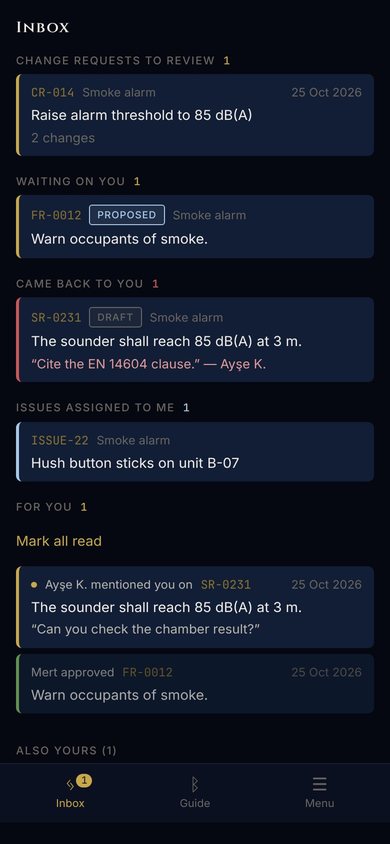
Each engineer sees what was returned to them, their drafts, what awaits their review, and the suspect links in requirements they own. Decisions and comments on your requirements arrive in an in-app inbox derived from the record itself. If you want, a short mail says that something waits, with a link and never the text. On a phone you have remembered, Bifrost can also buzz when something waits for you.
Exchange packages
Prime → subcontractor · signed
Hand a subcontractor exactly their scope: an architecture subtree with its Solution and Implementation requirements, links, attachments and upstream provenance, pinned to a baseline. Every package is signed; once the partner's key is registered it is encrypted end to end — no certificate authority, works air-gapped. The supplier receives it, builds under it, and returns their requirements with verification evidence and change requests; the prime accepts evidence and dispositions requests in the tool, and every step is a signed, baseline-pinned package in the ledger. A small team on either side of that contract can run the Lite edition — the same instance with the upper layers set aside — and it works just as well with a prime who sends a spreadsheet.
Change requests
Many changes · one review
Put a revised Need, its reworded Functions and their requantified Solutions into one change request, see what merging it would make suspect and which verification it would reopen, then merge it in one act — the requirements land approved on the text that was reviewed. Turn on protection and approved requirements change no other way. A merged change can be reverted the same way. Nothing approves on its own: every approval is a person's click, whatever their role. A change to a customer's line goes out in order (approved, sent, answered) and every round is kept.
Intake
What the customer sends · proposed for review
Drop a customer's mail, a Word document or a PDF, or paste notes from a meeting. On site, a folder can bring them in too, one per project, so a mailbox rule feeds it without anyone opening Bifrost. Or forward the mail to Huginn's own Intake address, or copy that address on a thread with the customer, and it follows the discussion. Huginn proposes the requirements in it, each beside the customer's own sentence, and the changes to lines you already have, current wording beside proposed. A proposal whose sentence or value is not in the text is dropped before anyone sees it. You accept, edit or reject each one, and the accepted ones become one draft change request in your name.
The Interview
The customer's sheet · built by asking you
Drop the customer's Excel or Word specification on Intake. Huginn reads it and asks you a stage at a time: the columns, which lines are binding word for word, then each line that holds two requirements, repeats another, uses a vague word or clashes with a binding line. In the full edition it proposes the Functions and Needs above your lines. What you settle becomes one draft change request in your name. Huginn onboarding asks four questions about a project you already have and drafts its description.
SysML v2 exchange
Baseline out · model back in
Publish any baseline as SysML v2 text — requirements by layer, derivations, the architecture as parts, allocation, verification cases — the same text every time, so two baselines diff cleanly in git. Edit the model in a SysML v2 editor and import it: architecture changes apply, requirement and link changes arrive as one change request to review. Behaviour and parametrics stay in your own model files.
Method & contract, shipped
Versioned · with the instance
The methodology text ships inside the backend, versioned, and is served to humans and agents alike — one method per instance. The client contract — enums, roles, the capability matrix — is generated from the backend, so the workbench cannot drift from the server it renders; any drift shows on the admin page.
Nothing here is a bolt-on workflow. Suspect, frozen, proposed, waiting, delivered — each is a position computed from the model, so it cannot disagree with the requirements underneath it.